-
- << >>
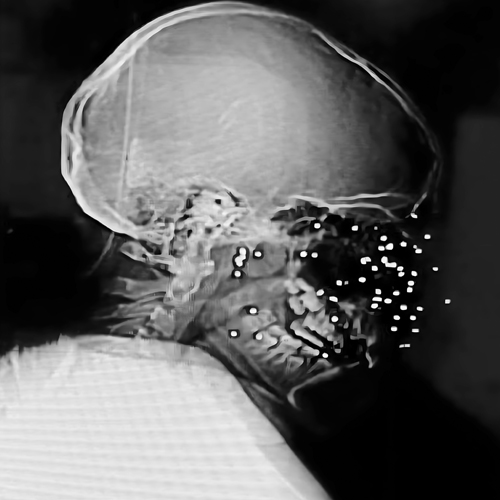
A scout image from a CT scan of a young Iranian protester following the massacre carried out by the Islamic regime in Iran on January 8–9, 2026.
The severe facial injury caused by shotgun pellets will result in the loss of vision for many of those shot. After the massacre, the Islamic regime shut down the Internet in Iran for 88 days in order to conceal the extent of the massacre and to cancel reports of executions, arrests, and the torture of prisoners.
In the following interview, an Iranian doctor - born in Iran before the Islamic Revolution and continuing to work there today - shares her story. To protect her privacy, this interview is published anonymously.
What is the most vivid memory from your childhood?
As a child, I enjoyed far greater freedom before the Islamic Revolution - than today.
I attended a mixed-gender class and there were plenty of activities available to us, such as dancing, singing or sport together with boys – things that children in Iran are not allowed to do today.
As women in Iran, we felt that there were no professional restrictions for us; we could, for example, work as judges. As young Iranian women Before the Islamic Revolution we, as young Iranian women, did not feel disadvantaged; but rather we were free to travel abroad and within Iran and to study wherever we wanted.
So if there was one particular image from my childhood that really stuck with me, it was this sense of freedom – that all doors were open to us.
What do you associate with the period before the 1979 Islamic Revolution in Iran?
My memories of the time before the Islamic Revolution are characterised by a childhood cheerfulness, a sense of security, and the fact that there was nothing to make me sad.
How did you experience the Islamic Revolution in Iran?
First and foremost, I associate the Islamic Revolution with fear.
I was afraid of religion, the headscarf and all the restrictions that, for me as a woman, came with them – for example, the separation of girls and boys at school or the limitations on educational opportunities for women.
My fear of religion stemmed from the fact that, up until that point, religion had played no part in my life, and I realised that if religion came to power, we would be living as if we were back in the Stone Age.
Why did you want to study medicine, and was there any ideological influence from the Islamic Republic of Iran on medicine as a science?
Actually, I was interested in physics and mathematics, as I wanted to study engineering in the oil industry.
I then decided to study medicine because, as a female engineer, I saw no job or career prospects under the Islamists. After the Islamic Revolution, this professional field was reserved for men.
Even within the medical sector, there were certain specialisms, such as urology, which were closed to women following the Islamic Revolution. Generally speaking, university places at that time were awarded on the basis of political views and gender rather than good academic results. This meant that, in some cases, people who were completely unqualified were admitted to degree programs.
The Islamic regime has a major influence on educational opportunities and the associated employment and career prospects.
It is therefore a very unfair system
Is your work as a doctor in Iran controlled by the Islamic regime?
Yes, for example, when we are preparing a female patient for an operation and helping her to undress, all male students and doctors must leave the operating theatre; the same applies the other way round.
I find this very disruptive to our medical work.
How did you experience the massacre carried out by the Islamic regime on 8–9 January, 2026?
I experienced the massacre myself and saw everything with my own eyes.
I heard the cries for Reza Pahlavi, his father, the former Shah of Iran, and the chant »Death to Khamenei« from the window of my flat and whilst I was driving. It wasn't for economic reasons that people took to the streets; rather, there was a political backdrop to the mass protests. The streets were full of people, and shots were fired directly at them.
The massacre on 8–9 January was so horrific that the next morning, when I drove to work very early, I saw bags, shoes and clothes belonging to injured demonstrators lying on the street. At the same time, the city’s cleaning services were busy clearing the blood of the injured and killed demonstrators from the road and pavements.
It was deeply distressing, and no one who witnessed it first-hand can ever forget it.
What opportunities did you have to help injured demonstrators?
As a doctor, I was asked for help by relatives and acquaintances. My colleagues and I helped the injured as best as we could.
Even colleagues who tend to be more supportive of the Islamic Republic helped the injured demonstrators, and some colleagues also made home visits to those injured in the massacre.
Following the massacre carried out by the Islamic regime, there were reports of injured people being killed by the regime's henchmen in hospitals, where they had actually hoped to find help. Were you aware of any such cases?
I have heard that injured demonstrators were shot dead by security forces in hospitals, but I did not witness this myself whilst working as a doctor. However, in the hospital mortuary, it was clear that some patients had been killed whilst receiving treatment in the clinic – for example, if they had a gunshot wound to the head and were still connected to a drip; such cases were always particularly striking.
In every state-run clinic, security forces have an office and there are always people on the ward working alongside them. Every patient admitted to the hospital is given a code, and the security personnel have access to these codes, so that they know at all times which patient is where in the hospital. In private hospitals, there are no such security personnel, and because they do not have direct access to patient records there, many employees of private hospitals were summoned for questioning after the massacre.
Most of the injuries were to the head, chest and genitals. In one eye clinic alone, following the massacre, 150 patients had to have one eye removed and 220 patients had to have both eyes removed. No one had expected such brutal state violence, and we were in a state of shock for a week.
We can no longer live as we did before the massacre. We still think it was just a nightmare and that the scenes we witnessed didn’t really happen. But, sadly, it was all real.
What help did injured Iranians receive who, out of fear of the security forces, did not go to a hospital or medical facility?
Medical staff who had helped injured demonstrators were arrested. They faced the death penalty and could only be released by paying a large sum in bail. Fellow doctors and nurses risked severe penalties if they made home visits to the injured.
There was a great deal of willingness to help amongst my colleagues, because they themselves are angry at the Islamic regime and the situation.
And doctors in particular who wish to go abroad were highly motivated to help, because they disagree with the Islamic regime. In particular, nurses went to great lengths to provide medical care for the injured.
There are doctors in Iran who have taken their own lives because they were unable to come to terms with the horror of the massacre, and there have been cases of medical staff being killed by the Islamic regime for treating injured demonstrators. How are you and your colleagues coping with the massacre?
Many doctors and medical support staff take antidepressants regularly, as this is the only way they can cope with the situation in Iran.
Their motivation to help the injured also stems from their despair over their own personal situation. They want to help everyone and have regarded the injured as if they were their own children or relatives. Even those with a more pro-regime stance have helped because they were swept up in the wave of solidarity and could not escape this atmosphere.
Suppose Iranian society were a patient coming to see you. What would you say are the most striking symptoms after almost 50 years of the Islamic Republic of Iran?
The first thing that strikes me, as a doctor, in this society is depression – coupled with enormous stress and uncertainty.
How long will it take for Iranian society to recover from the terror of the Islamic regime in Iran?
Iranian society will recover quickly once the Islamic regime has come to an end, because it is a very young society. The healing process will be faster for younger Iranians, as they have even more hope than their elders.
People in Iran have developed great resilience in the face of the Islamic regime's arbitrariness and violence in order to survive. Thanks to Iranian culture and history, the Islamists have not succeeded in winning over the majority of Iranian society to their ideology.
At the same time, post-colonial ideology at Western universities and academic institutions has enabled Islamists to successfully propagate their political agenda, with the result that, for example, the late revolutionary leader Khamenei praised students at elite American universities who showed sympathy for the terrorist militia Hamas as the »Axis of Resistance«. Or take the United Arab Emirates, which halted scholarships for British universities because it feared its students might be radicalised by Islamist ideology.
How do you explain the West's weakness in the face of Islamists?
First of all, Iranians have a completely different outlook on life and set of values to those dictated by the Islamic regime and demanded of them.
People who present themselves abroad as pro-regime voices can broadly be divided into two groups. Either they are lobbyists paid by the Islamic regime, or they have no idea about life and politics under the Islamic regime.
A young girl who takes to the streets in Paris or Berlin chanting »Free Palestine« and pro-Hamas slogans has never spent a single day living under the strict rules of the Islamic regime in Iran. They have absolutely no idea what it means for a woman to have to live under the Islamic regime in her everyday life. That is why I say once again that these young people abroad have no idea what they are supporting. And by the time they perhaps really do understand what they are defending, it may be too late.
We, as Iranians, have learnt the hard way that Islamists are not fit to govern a society.
As an Iranian woman, what do you associate with the word »freedom«?
For me, as an Iranian woman, the biggest problem is that we have no freedom of speech; everything else comes after that.
The lives people lead in public in Iran and their private lives are two different worlds. We always have to be careful what we say, and this self-censorship is making society sick. This is found in every social stratum of Iranian society, from academics to ordinary road workers. You cannot be yourself.
Our younger generation has taken a leap forward in this respect; they embody a greater inner freedom, but one which they cannot yet live out. The moment the Islamic regime falls, these young people will immediately start living according to their own ideas of freedom. And that life will not differ greatly from life in Western societies; perhaps it will be a little livelier and happier in Iran, as it is a young society.
It would be very good for Iran if we were to have this freedom one day.
What is the most important thing you have learnt after working as a doctor in Iran for many years?
The most important thing I have learnt in the course of my life is to be honest. And to try to live one's life with dignity and decency.
Like many other academics, you could have left Iran and worked abroad. Why did you stay in Iran?
As an Iranian, I feel a duty to help my fellow citizens.
I love Iran and, of course, I could live and work elsewhere. I decided against it because I realised that I am needed here.
What is your greatest longing as an Iranian woman?
I miss the childlike joy free from prejudice that I experienced in my childhood, as well as genuine encounters and a sense of calm in everyday life, and the fact that you cannot be yourself. And I miss the freedom of action and speech, and honesty, in Iran.
11 / 2026
<< >>